
SWC and Cannabis: The Complete Guide to Shallow Water Culture
⚠️ Important Disclaimer: All information in this article is provided solely for informational and educational purposes. We do not encourage the cultivation of plants prohibited by the laws of your country. Before starting any activity, please familiarize yourself with the criminal and administrative codes of your region. In many countries, cannabis cultivation is illegal and may be prosecuted by law.
Introduction: What is SWC?
If you've looked into hydroponics, you've likely heard the acronym DWC (Deep Water Culture). However, in expert grower circles, the term SWC (Shallow Water Culture) or sometimes "System Water Culture" is often used.
Essentially, SWC is a modification of classic DWC. The main difference lies in the volume of the nutrient solution and how it circulates. While in DWC roots simply hang in a large bucket with aeration, SWC often uses a smaller volume of water per plant but with more active circulation or a specifically shaped reservoir.
This method is considered the "Formula 1" of home growing: insane growth speed, but high demands on the "pilot's" skills.
How It Works: The Mechanics
The system is based on a simple principle: plant roots are constantly submerged in an oxygen-rich nutrient solution.
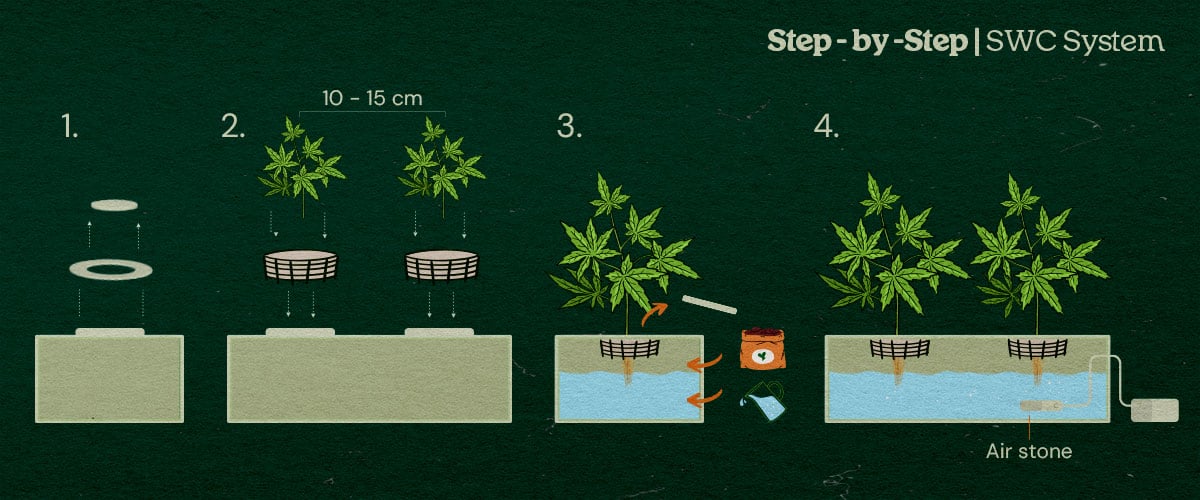
Net Pot: The plant is secured in a mesh pot filled with an inert substrate (expanded clay pebbles, foam glass).
Nutrient Solution: Roots grow through the pot directly into the water containing fertilizers.
Aeration (The Key): Inside the water, there is an air stone connected to a compressor. Air bubbles not only saturate the water with oxygen (vital for root respiration) but also create a "mist" of splashes that moisturize roots that haven't reached the water yet.
Why is it effective?
In soil, a plant spends energy searching for food and water, breaking through the dirt. In SWC, food and water are instantly available 24/7. All energy goes into green mass growth and bud formation.
Irrigation and Circulation Systems in SWC
Beginners often think SWC is just a "bucket of water." But for professional results, the irrigation and circulation system is crucial.
1. Top Feed (Drip System)
This is a hybrid system. While the root system is small and doesn't reach the water, a drip ring is installed at the top.
How it works: A small pump pushes the solution from the tank up to the base of the stem. The solution passes through the pebbles, wetting young roots, and drains back down.
Why it's needed: Accelerates vegetation by 30-40% in the first weeks. Once roots drop into the water, the top feed is usually turned off to avoid stem rot.
2. Recirculating (RDWC/R-SWC)
If you have more than one plant, you need a Recirculating SWC system.
The Essence: All buckets are connected by pipes to a single control reservoir.
Benefits: A powerful pump circulates the solution through the entire system. This guarantees that pH and fertilizer concentration (EC) are identical for all plants. It significantly simplifies maintenance and makes the system more stable.
Pros and Cons
An honest look at the technology is the foundation of trust (E-E-A-T).
✅ Advantages
Explosive Growth: Plants develop 30-50% faster than in soil.
Huge Yields: With proper light and nutrition, the size of the bushes is impressive.
Control: You know exactly what your plant is eating. No unpredictable elements like in soil.
Cleanliness: No dirt, soil, or soil-borne pests.
❌ Disadvantages and Risks
Temperature Dependence: This is the Achilles' heel of SWC. The solution temperature must be strictly 18–21°C. Above 24°C risks root rot (Pythium).
No Buffer: If the air pump fails or pH spikes, you only have a few hours to fix it before the plant suffers. In soil, this process takes days.
Noise: Air pumps (especially powerful ones) hum.
Equipment Checklist: What You Need to Start
To build a reliable system at home, you will need:
Reservoir: Light-proof bucket or container (15 to 30 liters per plant). Important: Light must not get inside, or algae will bloom.
Net Pot: Diameter selected to fit the tank lid.
Air Pump: Power calculation — minimum 1.5–2 liters of air per minute per 1 liter of solution. Do not skimp here!
Air Stone: A stone that disperses air. The smaller the bubbles, the better.
Substrate: Treated (washed and pH-balanced) expanded clay or foam glass.
Control Instruments:
pH Meter: To control acidity.
TDS/EC Meter: To control salt concentration.
Water Thermometer.
Expert Tips
Based on practical experience, here are the main nuances often overlooked:
Hygiene is Everything
In SWC, water is the blood of the system. Any dirt or bacteria multiply quickly. Use hydrogen peroxide or specialized enzymes (e.g., Cannazym) to prevent root diseases. Keep the tank sterile.
pH is the Key to the Lock
In hydroponics, nutrients are absorbed only within a specific pH range (usually 5.5 – 6.2 for cannabis).
If pH is 7.0, the plant starves, even if you poured a liter of fertilizer.
Watch the dynamics of pH. If it drops sharply — roots are rotting. If it rises sharply — the plant is eating actively.
Don't Overfeed
Beginners often burn plants with high dosages. In SWC (especially under LED lights), plants drink a lot of water, but they need fewer salts than the manufacturer writes on the bottle. Start with 25-50% of the recommended dose.


Write a comment