
Author: Alexey Grouman
Plant genetics and closed ecosystem specialist. 12 years of experience working with "mother" plants and mass cloning. Content verified by Grow-Tech technical department in January 2026.
Cannabis Cloning: A Complete Guide from Benefits to Cutting Technique
Cloning is the creation of an exact genetic copy of a "mother" plant. In advanced horticulture, this method is considered the gold standard for those seeking stability, quality, and maximum efficiency in their grow room.
Part 1. Why Professionals Choose Clones?
Unlike growing from seeds, where each plant has its own unique set of characteristics (phenotype), clones provide absolute predictability:
- 100% Female Plants: You permanently eliminate the risk of males appearing in your grow box.
- Uniform "Green Carpet": All plants have the same growth rate and height. This makes the Sea of Green (SOG) method highly effective.
- Time Efficiency: Clones allow you to shorten the grow cycle by 2-3 weeks by skipping the germination and seedling stages.
| Parameter | Clones (Genetic Copies) | Seeds (Hybrids) |
|---|---|---|
| Stability | 100% Identical | High Variability |
| Cost | Free (from own plant) | From $5 to $20 per unit |
💡 Pro Tip:
If you've found a unique phenotype with a rare aroma, seeds won't reproduce it. Cloning is the only way to preserve this "golden" genetics for decades by maintaining a mother plant.
Part 2. How to Properly Cut Clones: Step-by-Step Technique
Rooting success depends on how quickly you protect the cut from air exposure. Air embolism (an air pocket in the stem) is the leading cause of cutting failure.
Step 1: Preparation and Sterility
Use only sterile blades or professional scalpels. Prepare rockwool cubes or peat pellets by pre-soaking them in water with a pH of 5.5–5.8.
Step 2: The Perfect Cut
Choose healthy side shoots with 2-3 nodes. Make a cut at a 45-degree angle. This exposes a larger area of the cambium, where the roots will begin to develop.
Step 3: Hormonal Stimulation
Immediately dip the cut into a rooting gel (e.g., Clonex). Gel works better than powder because it tightly seals the stem, preventing contact with oxygen. Ensure the gel covers the bottom 1-2 cm of the stem.
Step 4: Creating a Microclimate
Place the clones in a propagator (humidity dome). For the first 48 hours, humidity should be at least 90%. Since the clones lack roots, they cannot drink water yet and must absorb moisture from the air through their leaves.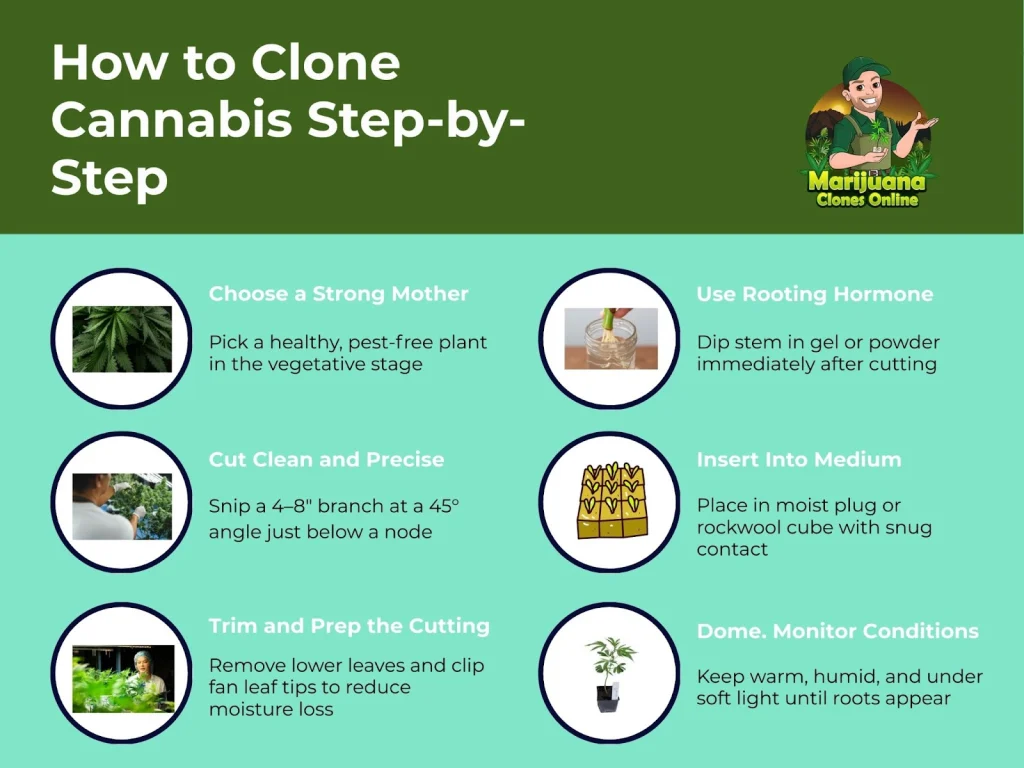
FAQ: Quick Answers to Important Questions
Why are my clones turning yellow?
This is normal. The plant is pulling nitrogen from the lower leaves to build new roots. Do not use fertilizers until you see the first roots emerging.
Can I clone during the flowering stage?
Yes, this method is called "Monster Cropping." These plants grow incredibly bushy, but the re-vegging process takes a significant amount of time.
Write a comment